

Why Small Firms Collect Payments Faster Than BigLaw — And How to Replicate Their Cash Velocity
For many small and boutique firms, cash doesn’t crawl in on day 90 — it lands within days. That’s not a fluke; it’s the result of deliberate choices about client experience, pricing clarity, payment options, and automation. In a market where client expectations mirror consumer-grade fintech, the firms that remove billing friction win on speed, satisfaction, and margin. This article explains why smaller firms often collect faster than BigLaw and offers a practical blueprint you can adopt — without sacrificing ethics, professionalism, or trust accounting discipline.
- Why many small firms collect faster than BigLaw
- Where small firms win: a quick comparison
- Blueprint: the intake-to-cash system that speeds payment
- Design a “no-surprises” client experience
- Tooling and automation: what to deploy (and where AI helps)
- Metrics that matter: reading your AR like a dashboard
- A 90‑day adoption playbook
- Ethics and compliance guardrails to honor
- Conclusion
Why many small firms collect faster than BigLaw
BigLaw excels at complex matters, panel relationships, and rigorous processes — but those strengths can slow collections. Layered approvals, matter budgets negotiated through procurement, LEDES coding cycles, and client-side eBilling reviews can push payment far into the future. Meanwhile, small firms typically optimize for decision velocity, client visibility, and payment convenience. They set expectations earlier, simplify choices, and automate follow‑ups so the “when and how” of paying is never ambiguous.
Speed comes from reducing friction across five moments that determine cash velocity: (1) fee clarity before engagement, (2) payment method availability at engagement, (3) billing cadence and readability, (4) automated nudges that feel helpful, not harassing, and (5) rapid exception handling when a bill is questioned. Master these, and your days sales outstanding (DSO) drops without aggressive collections.
“You don’t collect faster by chasing harder; you collect faster by designing a no‑surprises client experience.”

Where small firms win: a quick comparison
| Friction Point | Typical BigLaw Reality | Small/Boutique Advantage | Action You Can Take |
|---|---|---|---|
| Decision velocity | Multi‑layer review, billing committee standards | Partner‑level ownership of pricing and billing | Delegate pricing authority within guardrails; publish playbooks |
| Engagement terms | Lengthy engagement letters; late-stage negotiation | eSignature with plain‑English fee exhibits | Move signature to day 0; link to payment authorization |
| Payment methods | Check/ACH preferred; cards sometimes discouraged | Card, ACH, digital wallets, payment plans (where ethical) | Offer multiple compliant options; capture card/ACH‑on‑file |
| Retainer strategy | Fixed retainers that run dry | Evergreen retainers with auto‑replenishment | Set thresholds and auto‑notifications with client consent |
| Invoice readability | Dense entries, LEDES codes, legalese | Human‑readable narratives + summary upfront | Add a one‑page cover summary: scope, progress, next steps |
| Follow‑ups | Manual reminders, sporadic cadence | Automated, friendly schedule with self‑serve links | Automate 3‑touch sequences; include instant pay links |
| Dispute handling | Tickets, slow approvals | Direct attorney/manager resolution within 24–48 hours | Route invoice questions to a named owner; track to closure |
Blueprint: the intake-to-cash system that speeds payment
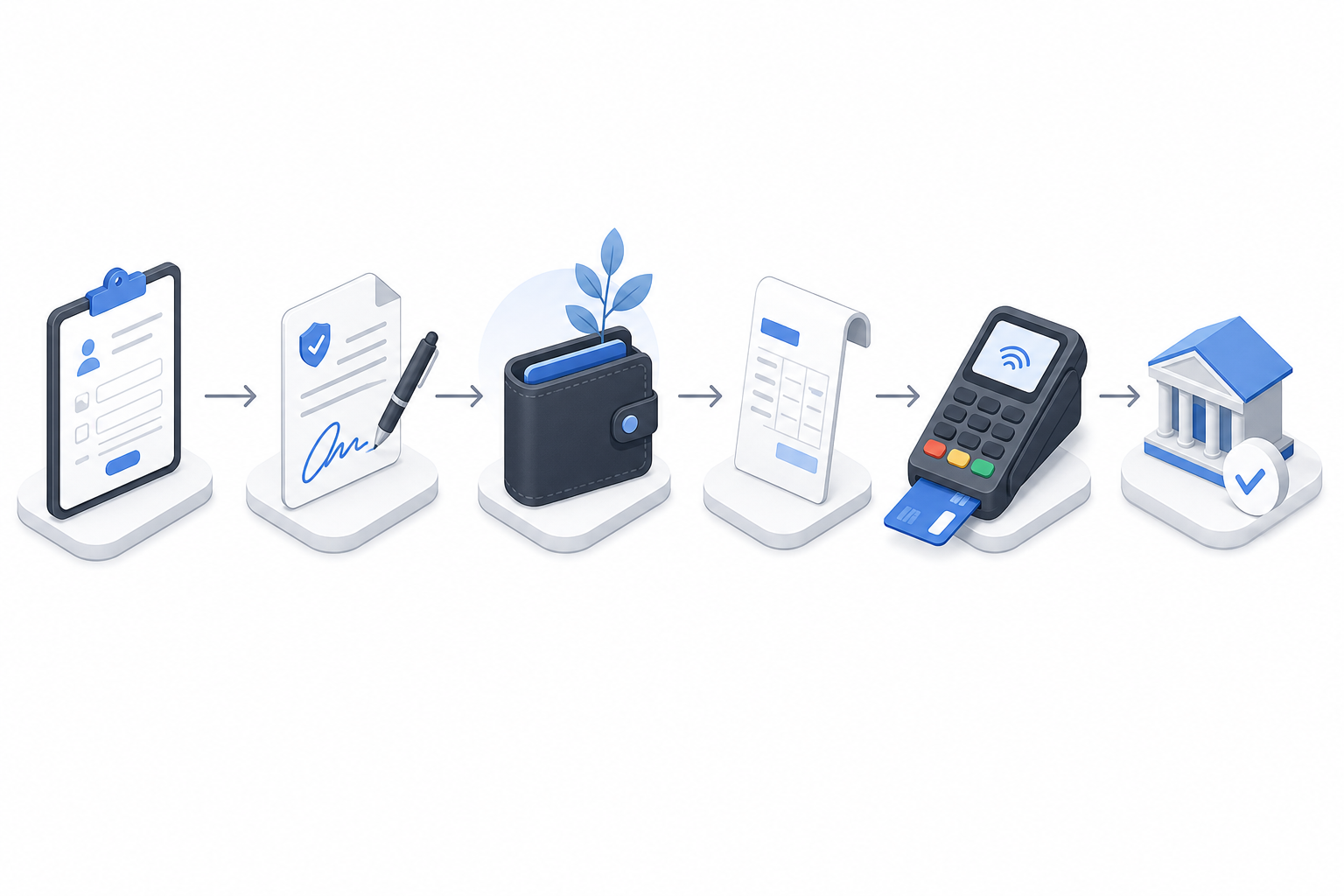
Fast‑paying firms don’t rely on heroics; they build a simple, automated pipeline from first contact to cleared funds. Think of it as a single workflow with six stages: intake, conflicts, scoping and fee proposal, eSignature with payment authorization, time capture and billing, and automated collections nudges with exceptions routing.
- Intake: Capture contact, matter type, urgency, and billing profile in a single digital form. Auto‑route to conflicts and triage queues.
- Scope and estimate: Use templates to produce a clear scope with assumptions, staged deliverables, and a “good‑better‑best” estimate where fit.
- Engagement + payment authorization: Combine eSignature with card/ACH authorization, evergreen retainer rules, and consent to electronic billing.
- Billing: Generate human‑readable invoices with a top‑line summary and detailed entries in an appendix or expandable section.
- Reminders: Schedule friendly, branded nudges at 3, 10, and 20 days post‑invoice with working “Pay Now” links.
- Exceptions: If a client clicks “Question This Charge,” route to a partner or operations manager with a 48‑hour SLA and templated responses.
Design a “no-surprises” client experience
Payment delay is often a trust problem masquerading as an accounts receivable problem. Clients stall when they’re startled by scope changes, uncertain about value, or unsure how to pay. Solve those anxieties proactively.
Make price expectations explicit
- Offer a concise fee summary at engagement: scope in/out, estimated range, and key assumptions. Avoid mystery and you’ll avoid month‑end debates.
- Use phased billing: Plan matters in stages with decision gates. Clients are more comfortable approving progress when they see milestones.
- Provide a “not to exceed without approval” clause for hourly matters to reinforce control.
Reduce cognitive load at payment time
- Embed one‑click payment links on invoices and reminder emails. Make it as easy as buying an airport coffee.
- Allow card, ACH, and digital wallet where permitted. Offer payment plans only where ethically compliant and appropriate for the matter.
- Send a same‑day “invoice explainer” summary: 2–3 bullet points on what was accomplished and what’s next.

Tooling and automation: what to deploy (and where AI helps)
You don’t need a monolithic platform to collect faster; you need a reliable spine with a few high‑leverage automations. Start with your practice management or billing system and augment where it counts.
- Payments platform: Enable card, ACH, and card‑on‑file/ACH‑on‑file with explicit client consent. Configure evergreen retainers with auto‑replenishment thresholds into trust accounts per your jurisdiction’s rules.
- eSignature + templates: Merge client data into engagement letters; include a pre‑authorized payment agreement and your e‑billing preferences.
- Invoice generation: Produce a one‑page summary cover with a plain‑English narrative, then attach the detailed time/LEDES export when required.
- Reminders and dunning: Automate a gentle, branded sequence (e.g., day 3, 10, 20). Include calendar‑friendly options like “schedule payment on Friday.”
- Dispute triage: A shared inbox or ticket tool that tags “invoice questions,” assigns an owner, and tracks resolution time.
- AI assists: Use AI to summarize time entries into a client‑friendly narrative, flag likely disputes (e.g., vague entries, admin‑sounding work), and suggest fee adjustments before the invoice goes out. Deploy AI to classify and prioritize AR exceptions, not to replace human approval.
Metrics that matter: reading your AR like a dashboard
Collections accelerate when you measure the right signals and act on them weekly. Treat AR like a flight deck, not a rear‑view mirror. The four metrics below give you line‑of‑sight to cash and client sentiment.
- DSO (Days Sales Outstanding): Your speedometer. Track by practice and billing attorney; intervene when it trends upward for a client or work type.
- AR aging buckets: Watch the “creep” from current to 30/60/90+ days. A healthy practice minimizes migration by preventing disputes pre‑invoice.
- Realization and collection rate: Separate write‑downs (pricing/efficiency) from write‑offs (collectability). The former is a pricing story; the latter is a process story.
- WIP aging: Slow WIP often predicts slow cash. Use WIP reviews to catch scope drift before it hits the invoice.

A 90‑day adoption playbook
- Days 1–30: Diagnose and design
- Map your current intake‑to‑cash workflow. Highlight delays: approval loops, manual steps, unclear handoffs.
- Decide on payment options to support (card, ACH, wallet) and where you’ll store payment credentials with consent.
- Draft a standard engagement packet: scope template, fee exhibit, evergreen retainer rules, eSignature, and payment authorization terms.
- Define your reminder cadence and tone. Pre‑write three friendly sequences.
- Days 31–60: Configure and pilot
- Turn on integrated payments and eSignature. Test end‑to‑end from intake to cleared payment.
- Create invoice cover summaries and AI‑assisted narrative checks for clarity.
- Pilot with one practice group or five clients. Track DSO, disputes, and client feedback weekly.
- Days 61–90: Roll out and refine
- Expand firm‑wide with short trainings and a “who to call” playbook for exceptions.
- Publish billing SLAs: invoice by X day each month, respond to questions within 48 hours, auto‑replenish at Y threshold.
- Review metrics every Friday. Celebrate wins (faster pay) and fix friction (recurring dispute themes).
Ethics and compliance guardrails to honor
Collecting faster never justifies cutting corners. A few non‑negotiables to keep front and center:
- Trust/IOLTA handling: Maintain strict separation of client funds. If you auto‑replenish an evergreen retainer, configure deposits to the trust account and document client consent and thresholds.
- Fee transparency: Use plain‑language engagement terms and provide timely notice of changes. Invite questions before billing, not after.
- Surcharges and convenience fees: If you pass on card costs, confirm your jurisdiction’s rules and card network requirements; disclose clearly and provide a no‑fee alternative like ACH where permitted.
- Privacy and security: Store payment credentials with PCI‑compliant providers; do not email card numbers or bank details.
- AI accountability: Keep a human in the loop for pricing decisions, write‑downs, and any communications that could affect the attorney‑client relationship.
Conclusion
Small and boutique firms often collect faster than BigLaw because they intentionally design for it. They simplify engagement, clarify scope, offer convenient payment options, automate reminders, and resolve questions quickly — all while honoring ethical and trust accounting obligations. You can replicate the same cash velocity by treating intake‑to‑cash as a single, client‑centered workflow, activating a few targeted automations, and managing to a handful of leading indicators. The result is not just quicker deposits; it’s fewer surprises, happier clients, and more time to practice law instead of chasing invoices.
Ready to explore how you can streamline your processes? Reach out to A.I. Solutions today for expert guidance and tailored strategies.